

The Empty Hall
How Trump’s building spree reveals an attack on culture, not an investment in it

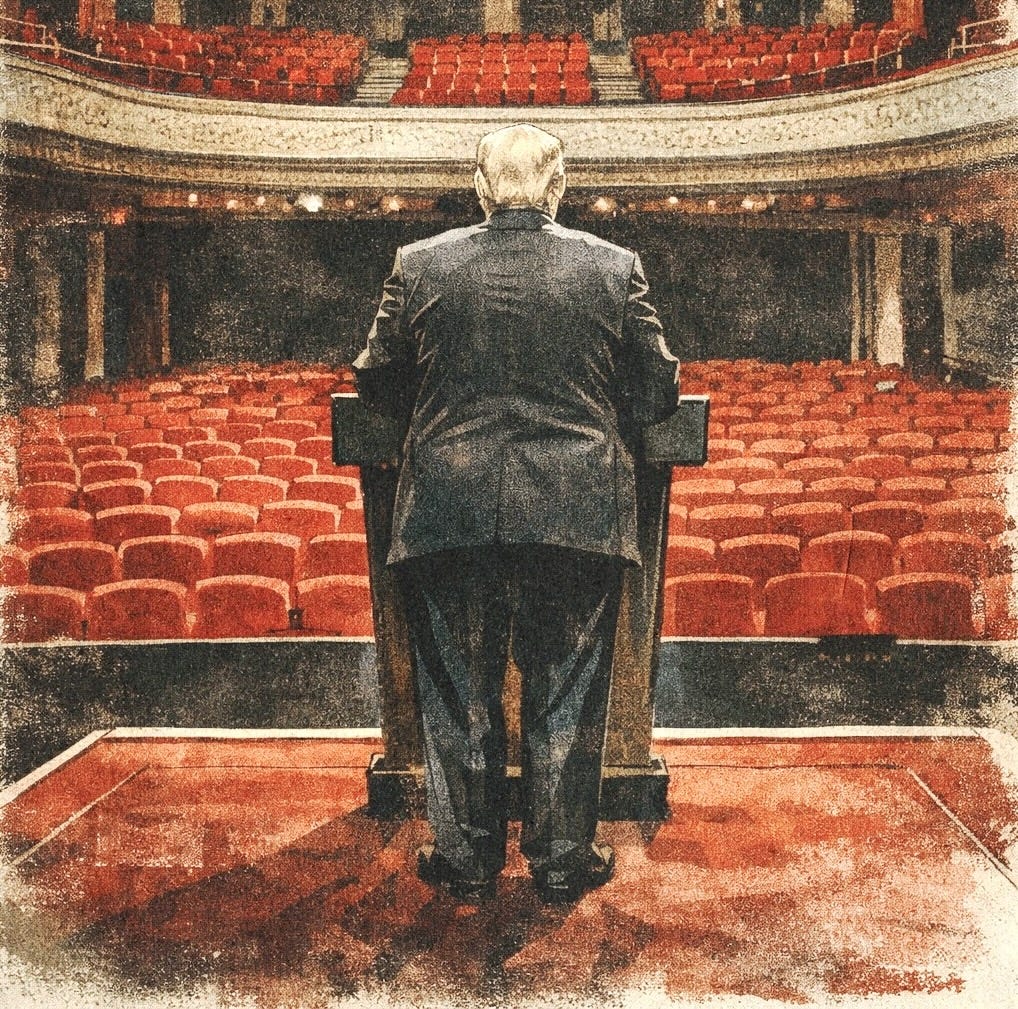
Donald Trump is dismantling the federal government while indulging in one of the most aggressive building fantasies Washington has seen in generations.
The dismantling is procedural. Agencies are weakened. Career staff are removed. Oversight is reframed as obstruction. Norms are not overturned in a single dramatic stroke but eroded through repetition and fatigue. At the same time, Trump is fixated on construction. New ballrooms. Proposed arches. Renamed institutions. Architectural renderings released as proof of permanence, even as the machinery of governance is hollowed out behind them.
This is not hypocrisy. It is coherence.
What Trump is undoing are institutions that rely on participation, professional independence, and consent. What he is trying to build are structures that do not. Culture lives almost entirely on the wrong side of that divide.
The Kennedy Center is not a neutral venue. It is one of the few national institutions where authority does not flow downward by design. Artists are not employees. Audiences are not captive. Prestige is not enforceable. It exists only so long as people continue to choose it.
Artists decided they didn’t want to be there anymore.
After Trump renamed the Kennedy Center, cancellations began. It became clear over time, not through a statement or a boycott, but through repetition, that artists were arriving at the same decision independently. Productions withdrew. Performers declined. The refusals were not logistical. They were reputational.
Instead of asking why people were leaving, the response was to close the doors.
Trump announced that the Kennedy Center would shut down for two years, officially framed as renovation. In practice, the move eliminated a different problem. A closed building cannot register rejection. A darkened calendar does not reflect absence. If no one can attend, no one can refuse.
This pattern has a history, and it’s worth naming it plainly.
When Adolf Hitler consolidated power, censorship was only one part of the project. He also turned obsessively toward architecture. Berlin was to be remade as Welthauptstadt Germania, a capital defined by scale rather than civic life. Vast halls designed to overwhelm the individual. A triumphal arch meant to dwarf the Arc de Triomphe. Spaces so enormous that conversation dissolved into insignificance.
These buildings were not meant to host culture. They were meant to replace it.
Living institutions are inconvenient. Artists interpret. Audiences respond. Meaning shifts over time, sometimes in ways power does not control. Monuments exist to avoid that problem. Stone doesn’t reinterpret itself, and buildings don’t cancel appearances.
The point here is not ideological equivalence. This is about how authority behaves once it stops trusting participation.
Trump’s proposed White House ballroom follows this logic precisely. It is not a functional necessity. It is a managed environment. The guest list is controlled, the tone is managed, and dissent never quite makes it into the room. Ballrooms do not require persuasion. They require invitations.
The proposed national arch is even more revealing. Trump has described it as the largest in the world, explicitly designed to dominate the landscape and outscale existing monuments. Arches commemorate victory. They do not invite interpretation. They announce conclusions.
This is the trade being made: living culture exchanged for fixed symbols, participation replaced with display, engagement reduced to scale.
The Kennedy Center resists this substitution by its very nature. It depends on voluntary presence. It requires trust. It functions only when people want to be in the room.
It is also not symbolic infrastructure. It is real infrastructure.
The people who make these spaces function, stagehands, designers, musicians, educators, technicians, feel that interruption immediately. Closing the Center interrupts careers, seasons, and the slow accumulation of work that keeps cultural institutions alive. It severs touring routes. It halts commissions. It removes public access to culture that is not filtered through private markets or loyalty tests.
Trump has never shown interest in nurturing institutions that outlast him. His cultural instincts were formed in environments where hierarchy is explicit and control is centralized. In those systems, participation came with conditions, and prestige was something you were granted rather than something you helped shape.
That approach works poorly in spaces that depend on interpretation instead of obedience.
Rather than accommodate that friction, culture is taken out of the room.
What’s left is a building with no one in it.
Power is usually very clear about what it can force. It is far less comfortable acknowledging what it can’t persuade. When people stop showing up, that absence speaks more clearly than any protest.
The Kennedy Center does not argue or issue statements. It simply sits unused, marking a limit this administration has shown little interest in rebuilding.
What’s missing is a willingness to share space with culture without needing to control it.
Until then, the lights remain down, the stage stays empty, and the hall waits, not as a symbol of resistance, but as a quiet record of what happens when power demands loyalty from institutions that require trust instead.